Brown Noise for Focus, Without Another Tab Open
Most focus sound lives inside the most distracting website you own. What brown noise is, whether it helps, and how to play it with the sites that distract you blocked.
November 2026 · 3 min read
You want ten minutes of brown noise, so you open YouTube. The video starts, the sidebar suggests something better, and forty minutes later you know a lot about a ship that sank in 1912.
The sound was never the problem. The problem is where it lives. Most focus sound sits inside the single most distracting website you own.
What brown noise actually is
White noise has equal energy at every frequency, which is why it hisses like an untuned radio. Pink noise tilts that toward the lows. Brown noise tilts it further, so it sounds like a deep, even rumble: a waterfall, a train, the inside of a plane.
Does it help? Honestly, it depends on you. The studies are small and point both ways. Steady noise seems to help some people concentrate, people with ADHD in particular, and does nothing much for others. What almost everyone agrees on is that it masks the sudden sounds that pull your head up: a door, a voice, a notification.
So the useful question isn't “does brown noise work”. It's “does it work for me”, and you only find that out by trying it during real work.
Sound that starts when you start
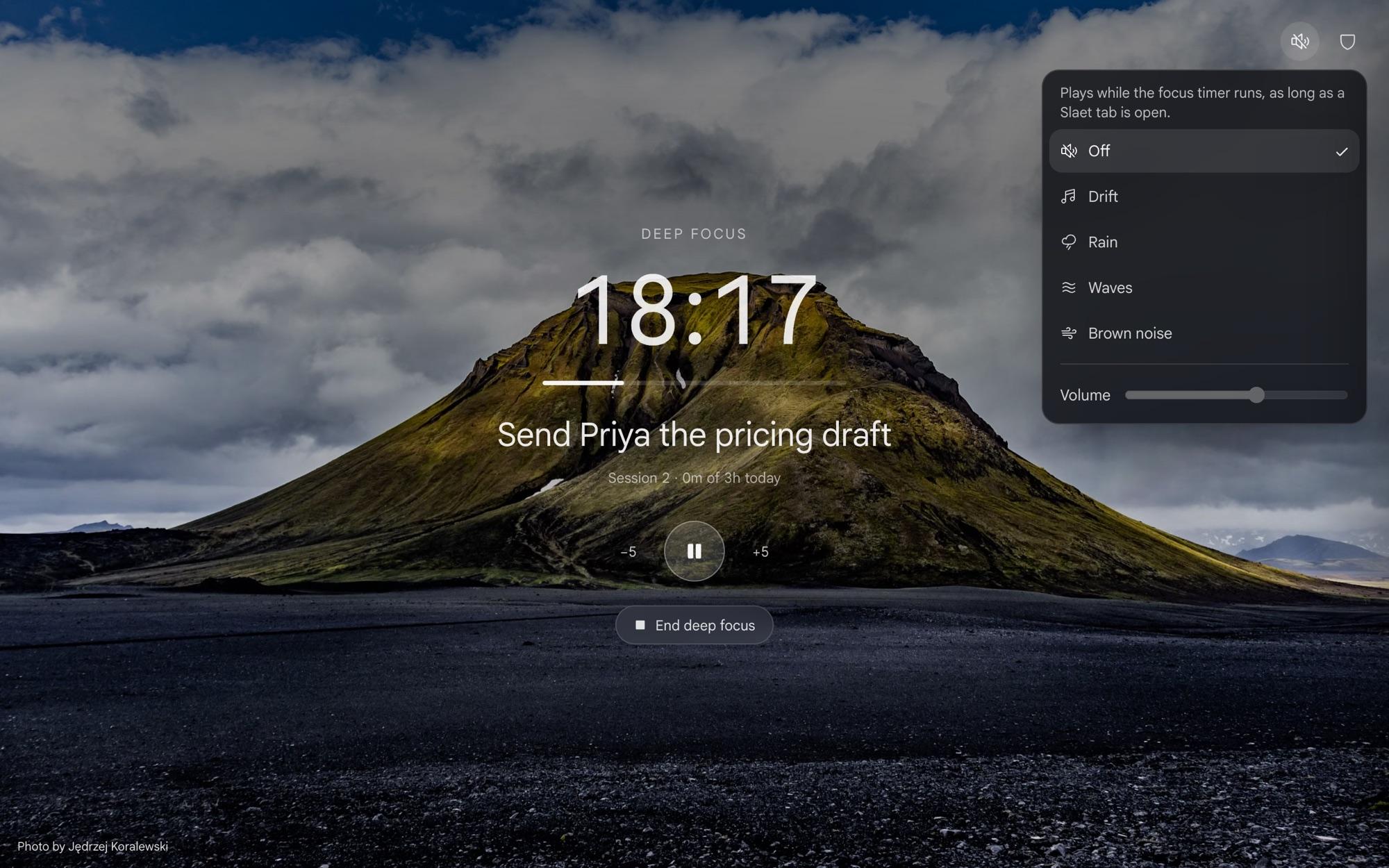
Slaet puts four sounds inside Deep focus: drift, rain, waves and brown noise. Start a session on a task, pick a sound, set the volume. It plays while the timer runs and stops when the session ends.
No video, no autoplay, no sidebar. And because Deep focus can block sites for the length of the session, YouTube can stay shut while you listen. How the blocker works is in Slaet vs BlockSite.
Which sound for which work
This is taste, not science, but it's where I'd start:
- Brown noise for a noisy room. It covers voices best.
- Rain for writing. It's steady with a little texture, so it doesn't feel like silence.
- Waves for long, slow work like reading or reviewing. The rise and fall is easy to stop hearing.
- Drift when noise feels harsh. It's the softest of the four.
Keep the volume low. It should be a floor under your thoughts, not something you listen to.
Where Slaet stops
Four sounds is a short list on purpose. There's no mixer, no layering, no playlists. If you want to blend rain with a coffee shop and a fireplace, a dedicated app like Noisli or myNoise does that far better. Slaet's job is narrower: one steady sound, tied to the task you're doing, that switches off when you're done.
If picking the task is the hard part, start with one task on the screen. And if you know the task but still can't start it, that's the intention-action gap.
Frequently asked questions
What is brown noise?
Steady noise with most of its energy in the low frequencies. It sounds deeper and softer than white noise, closer to a waterfall or the hum inside a plane than to radio static.
Does brown noise help you focus?
For some people, yes. The research is small and mixed: steady background noise seems to help some people concentrate, especially people with ADHD, and does little or nothing for others. Try it for a week of real work and judge for yourself.
Which sounds does Slaet have?
Four: drift, rain, waves and brown noise, with a volume slider. They play during a Deep focus session in the Slaet extension.
Do I need to keep a tab open for the sound?
Any Slaet tab will do. The sound plays while the focus timer runs, as long as a Slaet tab is open, and stops when the session ends.
Slaet for Chrome, Brave and Edge
A task, a timer and brown noise, on the tab you were opening anyway.